

The salmon broccoli omega boost cat food topper was the jar my cat finished first. It is a plain bake most cats take, and the salmon is the part to keep.
Is salmon and broccoli actually safe for cats, and will mine even eat it? That’s what I asked my vet before I started making this salmon and broccoli omega boost recipe for my tabby, Miso, whose winter coat had turned dull and flaky. The short answer: yes, when it’s cooked properly, kept plain, and served as a topper rather than a full diet. The longer answer is what I’ve worked out over about a year of tweaking this in my own kitchen.
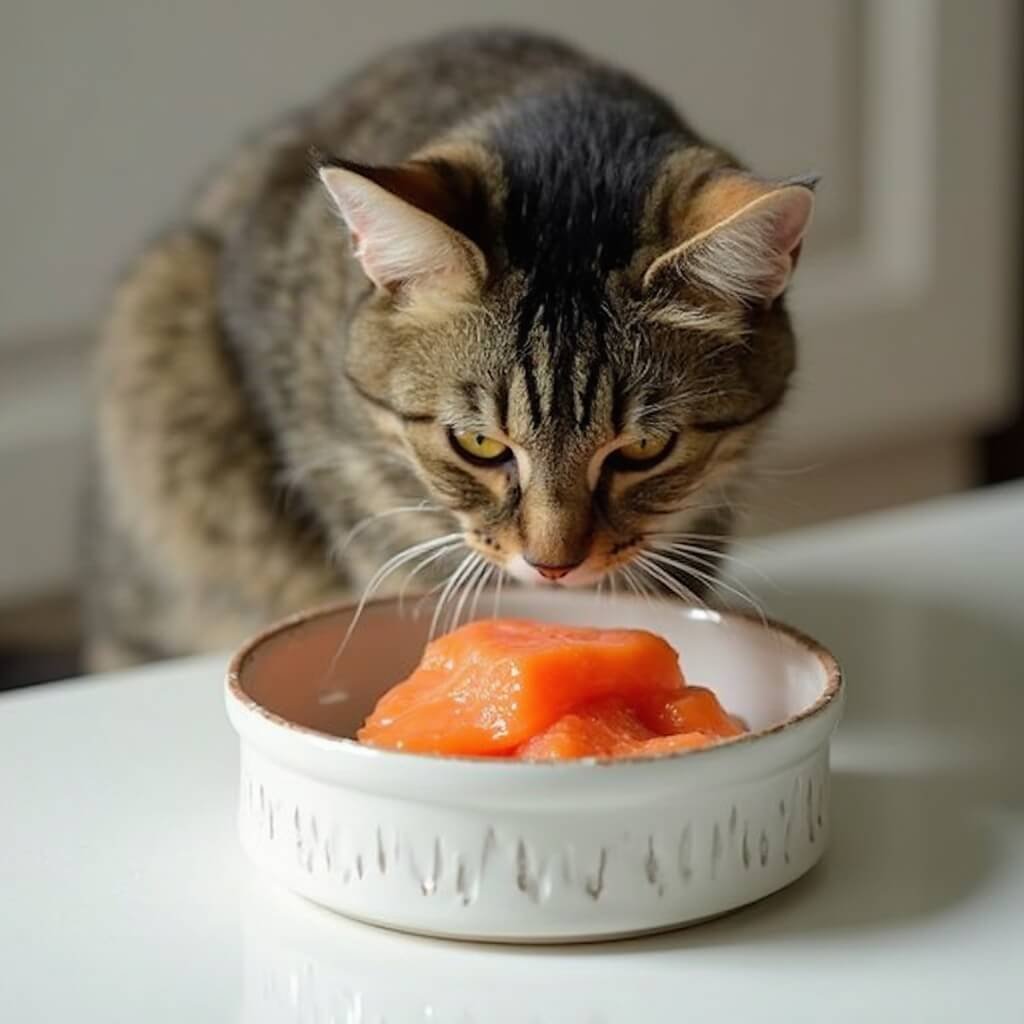
I’ll say upfront — this isn’t a complete, balanced diet on its own. I feed it as a meal topper or occasional treat over Miso’s regular wet food, and within about three weeks of starting it, the flaking stopped and his coat looked noticeably glossier. That’s the only reason I keep making it.
Key Info
– Prep time: 10–15 minutes
– Cook time: 10–15 minutes
– Total time: 20–30 minutes (including cool-down)
– Servings: 4–6 cat portions (about 1.5–2 cups finished)
– Calories (per portion): ~85 kcal
– Fat: ~5 g
– Protein: ~9 g
– Carbohydrates: ~1 g
– Difficulty: Easy
– Dietary tags: Grain-free, high-protein, omega-3 rich, no added salt
Equipment You Actually Need
– Nonstick skillet for the salmon and eggs
– Small pot with steamer insert (or a microwave-safe covered bowl works fine)
– Sharp knife and cutting board
– Mixing bowl
– Fork or small whisk for the eggs
– Spatula
– Measuring spoons — especially for the fish oil, don’t eyeball this
– Food processor or blender (optional, but if your cat prefers pate texture, get one out)
– Ice cube tray for freezing portions

A baking dish in the oven works instead of the skillet if you’d rather bake the salmon. A fork does the same job as a blender if you want chunkier texture.
Ingredients
For about 4–6 cat-sized portions:
– 1 cup cooked boneless salmon, flaked (200–220 g) — fresh, frozen, or canned in water and drained
– 2–3 tbsp finely chopped steamed broccoli (20–30 g)
– 1–2 large eggs, fully cooked
– 1–2 tbsp fish oil or salmon oil (split across the full batch, not per serving)
– 2–4 tbsp warm water or unsalted, onion- and garlic-free broth, as needed
– A few drops of plain olive or coconut oil for the pan
What stays out: no salt, no onion, no garlic, no chives, no leeks, no pepper, no herbs, no butter, no flavored oils. These range from irritating to genuinely toxic for cats. I’m strict about this and you should be too.
Substitutions worth knowing:
– Whitefish or another vet-approved cooked fish can replace some of the salmon if your cat tolerates it better.
– Pumpkin puree, well-cooked carrot, or a tiny bit of cooked spinach can swap in for some of the broccoli.
– Algal or krill oil instead of fish oil, if you’re avoiding fish-sourced supplements — ask your vet for dosing.
What I Learned the Hard Way
The first time I made this, I used canned salmon with bones — the soft, pressure-cooked kind that’s safe for humans. I figured it was fine. It mostly was, but I found one tiny sharp fragment when I was mashing it. Now I always run my fingers through the flaked salmon twice before mixing. Cheap insurance.

I also used too much broccoli at first (closer to half a cup) because I thought more veg meant healthier. Miso got gas. Bad gas. Two tablespoons across the whole batch is the sweet spot.
Method
1. Steam the broccoli.
Cut two or three small florets into tiny pieces. Steam for 3–5 minutes until they’re bright green and a spoon edge cuts through easily. Drain, cool, then chop very fine. Big pieces are hard for cats to digest.
2. Cook the salmon.
Warm a few drops of oil in a nonstick pan over medium heat. Add the salmon. Cook 3–5 minutes per side for a fillet, until the flesh turns fully opaque and flakes apart with a fork. No translucent center. Move it off the heat, let it cool enough to handle, then remove every bit of skin and bone. Flake it small.
3. Cook the eggs.
Beat the eggs in a bowl. Pour into the same pan and stir gently until completely set — no shiny wet bits, no runny center. Raw egg is a no-go for cats: salmonella risk plus the avidin in raw whites interferes with biotin absorption. Cool slightly.

4. Combine.
In your mixing bowl, add the flaked salmon, chopped broccoli, and cooked egg. Drizzle in the fish oil now, while the mixture is warm but not hot — high heat damages omega-3s. Add a tablespoon or two of warm water or broth if it looks dry.
5. Adjust the texture.
For pate-style, pulse it in a food processor until it’s evenly mixed and soft but not soupy. For chunky, mash with a fork and leave small flakes of salmon visible. Miso prefers the chunky version. Your cat will let you know.
6. Cool and portion.
Let the mixture come to room temperature. Spoon into an ice cube tray or small containers — each cube is about a tablespoon, which is a useful unit for topping a regular meal.
7. Serve.
Use 1–2 tablespoons mixed into your cat’s regular complete food, or serve a small portion solo as a treat. Introduce it over 5–7 days, starting with half a teaspoon, so you can watch for any reaction.
The salmon broccoli omega boost cat food topper is the jar most cats take. The salmon is the part to keep.
